Saturday, October 21, 2023

Puttin’ Up Apples to Freeze


Well, we bought a bushel of Arkansas Black apples for Mom and Dad when we visited the mountains last week.

After a few days of recuperating from vacation, I went to their house so we could put them up.

A full bushel box of apples could look a little daunting, but we made pretty quick work of it.


Mom couldn’t see into the box from where she was sitting and asked a time or two if we were about done. I told her that maybe Jesus would make our bushel of apples bottomless like he did with the loaves of bread and fishes for the multitude. I think she was okay with just a regular bushel.
We all peeled, cored, and sliced the apples. Then we tossed them into a container with lemon water in it. Our lemon water was getting full of apple slices so we needed to get them ready for the freezer so we could put more apple slices into our lemoned water. 


Mom and Dad had gotten one of those vacuum sealer things at Costco. Dad gave me the instructions and asked me to figure it out so we could package what we had already.


Fortunately, the instructions were pretty straightforward and it was easy to use.

I scooped out apple slices to drain so I could package them. After they drained well, I put them into bags and used the vacuum and seal machine to seal them up beautifully! 


Before we had this new gadget, we just put the apples into quart freezer bags, trying to get out as much air as possible, before zipping them. We couldn’t get much air out but that vacuum sure did a great job!!

I continued packaging while Dad and Mom kept peeling, coring, and slicing. 


I think that it took us less than three hours and we ended up with 24 “quarts” of apples to freeze and pull out and fry at a later date!


Tucked away in the freezer.

After getting the apples ready for the freezer, we enjoyed a wonderful dinner of white beans, diced onion, cornbread, and well lemoned iced tea!
Dad and Mom sure know how to feed a girl! 
 

Tuesday, October 3, 2023

The Minutia of Memories


The Minutia of Memories; A Jooniebug and Grannyma Tale

Jooniebug was visiting with Baba and Grannyma. As they often did, Grannyma and Jooniebug were looking at old family photos. This was one activity that they often enjoyed during their visits.

Jooniebug gave Grannyma a squeezy hug and asked, “Grannyma, do you remember your grannyma and baba?”

“Darlin’, I remember at least a little about the ones that I got to meet I remember your Pepaw’s mother and father. Remember, Pepaw’s mom’s name was Nancy Middleton Smith and his dad’s name was David Smith, like my brother David’s name?”


Jooniebug nodded and Grannyma continued, “I called her Grandma and I called him Grandpa. I loved them oh so very much. They were so sweet and loving. I don’t ever remember their voices raised in anger. I imagine that they did get angry at times, but I never recognized it if it happened when I was around.

“When I was a little girl like you, Pepaw, Grandma, Grannyma, and Uncle David lived in Dayton, Ohio. As often as possible, Pepaw and Grandma would load your Uncle David and I into the car and we would drive down to Anglin Branch in Owsley County Kentucky to visit with Grandpa and Grandma Smith.

“Grandma Smith had long white hair that she kept pulled back in a bun with tortoise shell combs and pins. She wore roundish wire-rimmed glasses over her blue eyes and her cheeks seemed to always have a rosy glow, perhaps from the heat of the kitchen that she spent so much time in. When I was young, she was plump. As she aged, she became thinner, but when I was young, she was pleasingly plump.


“It seems that she was always in the kitchen, so most of the time, her simple cotton housedress was covered with a bibbed apron. Grandma seemed to love to go barefoot; outside, in the house, everywhere. I can close my eyes and imagine the sound of Grandma’s bare feet shuffling over the green tile of the kitchen floor.

“When Grandma did wear shoes. I remember a simple pair of black leather shoes with an X cut into the leather over the outside toe area. She must have had a painful corn. That may be why she seemed to dislike wearing shoes?

“When I knew her, Grandma was rather quiet. She had had a very bad stroke a few years prior to my birth and had almost died. Perhaps this stroke had made her quiet, as older cousins remember her being rather chatty. I wish that I could have known that chatty Grandma, but I could not have loved her any more than my quiet Grandma.

“Now, Grandpa Smith was a slender man with white hair and wire-rimmed glasses that covered his blue eyes. Those blue eyes usually had a twinkle in them that made a person wonder what kind of mischief he was up to!

“He usually wore overalls over a long-sleeved shirt and he often wore a fedora hat. If he wasn’t wearing overalls, he usually wore work clothes type khakis with a similar shirt.


“Grandpa was a busy man. He had the animals to take care of. He had gardens and tobacco bases to tend to. He had to collect white clay from the top of the drive to reline the fireplace before use in the winter. Coal was needed for the stove and fireplace, and he had to collect enough coal from the coal pile out back to bring in for the warm morning stove and the fireplace in winter.

“He had trees and grape vines to prune. He had maintenance of the house, the two barns, the fences, … to attend to. He had to cut up and remove trees that had fallen during storms. He had tools to mend and sharpen, barns to clean out. He had to get a ride to go purchase feed for the animals when necessary. Grandma would very, very rarely leave the home place. Grandpa would be the one to get a ride to go to the general store in Booneville or Manchester to buy the items that they couldn’t raise on their own. He would choose the birthday cards to send to children, grandchildren.

"Grandpa would also be the one to walk up to the road to collect the mail. Your Pepaw and Grandma say that he would always keep a keen eye out for the postman. I suppose that he was hungry for news from children, grandchildren, news from the outside world. Grandpa was interested in news. He always took a newspaper so he could know what was going on beyond his holler. As soon as Grandpa saw the postman coming, he would head up the lane to collect whatever he had brought.

“Grandpa and Grandma lived out in a very isolated area. There were several families that lived up and down their road, but they were not right next to each other and there was quite a bit of land between their homes. They could only see one neighbor’s house from their home.

"Visiting Grandpa and Grandma was almost like traveling back in time, almost magical. They lived on a sliver of flat creek bottomland. Several yards in front of their home on a little rise ran a narrow gravel road. That gravel would get washed away over time and it would become a mostly dirt road. Steep hills were just to the far side of that road. That mostly dirt road had curves and little hills. When it rained, that dirt became mud. Pepaw is a wonderful driver, but even he had trouble driving on the road to Grandma and Grandpa’s house when it rained and the road became a mud slick. Sometimes, Pepaw would have to stop the car and we would have to walk the rest of the way to Grandpa and Grandma’s house through the mud.
  
                         Glenna Allen on Anglin Branch Road

         Karyn Sutherland Albert Temple on Anglin Branch Road

“A creek ran several feet behind, and a bit lower than their house. Just beyond the creek, were more steep hills. Your Uncle David and I, and myriad cousins loved to wade in that creek. We would wade in search of tadpoles, minnows, and crawdaddies. Water striders with their long legs would walk on the water. Dragonflies with their iridescent wings would flit among the tall grasses lining the creek bank. All the time, the lazy music of the creek flowing downstream could be heard in the background.
 
                Darryl Allen and David Smith in Anglin Branch

                   Patricia "Sissy" Allen Rex in Anglin Branch

“Grandma and Grandpa’s house was sort of cradled by hills. I like saying that they were embraced by the hills surrounding them because it was such a peaceful haven there; like a mother’s embrace is a comforting haven for her baby.”

Jooniebug piped up, “Like when you hug me Grannyma!”

 “Exactly like that Jooniebug! Exactly!”


“The house was a little white frame house with a metal roof. When it rained, the rain played lovely music on that tin roof. Nature’s music always played in the background. The music of the creek tumbling on its way toward the ocean, the music of rain on the tin roof, the music of the wind soughing through the trees, the music of a rooster crowing in the distance, the constant hum of insects vibrating in the air, the bark of a dog, the lowing of the cow, the rare sound of a car crunching gravel on its way along the road in front of the house…: This music was a lovely accompaniment to our visits with Grandpa and Grandma.
 
                           Rough floor plan. 

"The house had a covered back porch outside the kitchen area. To the right of this porch was a covered, dug well. At one time a mulberry tree rose up beside and reached over the well. It died and a bare dead tree trunk is what I remember rising beside the well. 

Donald and Loretta Nolen Smith with porch and mulberry tree visible

           The back porch, the well, and the mulberry tree remains.

"Steps made from stone led up onto this porch. You might see a blue-tailed skink darting up the side of those steps or up the side of the well. A wash pan often hung on the wall of the house just to the left of the back door. At one time, an old wringer washer was on the back porch. The back porch was a collecting place for various odds and ends; a bucket, a mop, a broom…
 
Billy Nolen and Gayle Smith on back porch; steps, well, and mulberry tree visible


"Inside, the walls and ceilings of the house were  painted knotty pine tongue and groove slats. The floors were covered by vinyl rugs except for the green-tiled floor in the kitchen area. 
 
Nancy Middleton Smith and Dave Smith with tongue and groove walls visible.

“Grandpa and Grandma had electricity, but they didn’t have all of the electronic gadgets that you are used to. They had ceiling lights, a stove, a refrigerator, and they had a radio. Years later they would add a TV, but when I was very small, they didn’t have the TV.

"Since they were cradled by the hills, when they did get a TV, the antenna had to be at the top of the steep hill behind Grandpa and Grandma’s house in order to receive the signals. When the TV reception got bad, Grandpa would have to climb up that steep hill, clearing any limbs that may have fallen on the line during storms, and turning the antenna in a better direction to pick up the signals. Something as simple as watching TV could become a real chore for Grandpa.

“Grandpa and Grandma didn’t have central heat and air-conditioning. They had a coal burning warm morning stove in the living area and a fireplace with a coal grate in one of the bedrooms for heat. They raised the windows, which had screens, in hopes that circulating air might provide a cooling breeze during hot weather. They could have had an electric box fan to put in a window, but I don’t really remember one?

“Grandma and Grandpa had running water at the kitchen sink, but we drank water that Grandma drew from the well outside the back door. She would lower an empty bucket down into the well and draw a bucket full of water up to the top. She would then pour the water into a bucket that she would carry inside to the dining area. There she put it on the enameled Hoosier cabinet with a tin dipper in the bucket. Everyone drank from that same dipper when they were thirsty. The water that Grandma drew from that well tasted so cold and crisp. She just kept the water on the cabinet, not in the refrigerator, but it seemed to somehow stay cold!

"They didn’t have an indoor bathroom. They had a two-seater outhouse down the lane which was about the size of a closet. The outhouse had a bench just inside the door along the back wall and the bench had two holes cut into it. This bench with its holes served as a commode. There was no toilet tissue. There was a stack of old catalogues and magazines on the bench between the 'seats'. Pages were torn from these catalogues and were used as toilet paper.

"Chamber pots, or recycled lard stands would be under the edge of the bedsteads if you felt the urge to go at night. It got very dark in the hills at night as there were no city lights. I would never want to walk to the outhouse in the dark. I reckon that the grown-ups didn’t want to either!

“The house had five small rooms. When you came through the back door, you entered into the tiny kitchen area with the stove on the right and a sink at the end of a short counter next to the stove. There was a circular fluorescent light in the kitchen and It made a faint buzzing sound. To the left was a dining area with a table and chairs on the left side, the Hoosier cabinet which held the water bucket and dipper on the right side, and the refrigerator was in the corner. 
 
  
Loretta Nolen Smith and Donald Smith standing in kitchen with refrigerator in corner of dining area visible.

“Now, all of Dave and Nancy’s young’uns loved sweets and Grandma could make some delicious treats in that kitchen. She made some yummy tea cakes that were soft like biscuits but thinner and with a touch of sorghum sweetness. She made cakes, cobblers, pies… and her family was happy to gobble them up.

“One time when Grandma was making lemon méringue pie, I must have been in that kitchen underfoot. She must have decided that I would be more out of the way if she kept me busy making my own pie! She gave me a metal Bob White syrup lid and a little ball of piecrust dough. She rolled out her piecrust and then I rolled out mine. We carefully put our crusts into our pie ‘tins’ and put them into the oven to bake.

“As the crusts were baking, Grandma cooked up a batch of lemon pie filling. She bought pie filling mixes from the Rawleigh or Watkins traveling salesman. In the past, she had sold Rawleigh products. Pepaw recalls her riding the mule to the neighbors to take orders and then again to deliver the Rawleigh products. By the time I came along, she usually stayed at home. I imagine the stroke she had had made it difficult for her to continue her little business.

“After our pie crusts were done and had cooled and the filling had cooled a bit, Grandma let me put a generous spoonful of filling into my little crust before filling her crust. She then beat egg whites and sugar until they made stiff peaks. I spread a bit of the meringue onto my little pie, and she spread the rest onto her larger pie. We put them back into the oven so the meringue could turn a lovely caramel color! I was so proud of my little pie. I knew that Grandma was a wonderful cook and I knew that my pie would be delicious just like hers!

“If after coming in from the back porch, you walked straight through the kitchen, the next room was the main living area. The warm morning stove was in this room in front of an old unused coal grate on the left. The entrance to Grandma’s canning closet was on the wall to the left of the stove. Instead of a door, a cloth curtain served as a door. On the right, as you entered this room, was an iron bedstead against the wall. Straight ahead, on the opposite wall was a door to the front porch. To the right of the door was a couch. There might be varying numbers of straight-backed chairs in the living room, pulled there as needed by folks needing a seat.

“In the left front corner of this room was a door that led into the front bedroom. As you walked into this room, two iron bedsteads were on the far wall. When we visited, we slept on those bedsteads.

"The frames were simple iron without any frilly curly-cues. but they had seen several coats of paint as adornment. There was a thin mattress on top of a thin wire rack of springs on each of the beds. In the winter, these beds were piled high with the quilts that Grandma had made.

"The coal grate provided the only heat and as we lay cuddled by those quilts, we could hear the popping of coal in the grate. With each pop, embers flew up the chimney like tiny fireworks. Any time you rolled or shifted while lying on those beds, you could hear the creaking of those springs under the mattress.

"An old treadle sewing machine was on the wall between the beds. A door to the front porch was just to the right as you entered this room. So, Grandpa and Grandma’s house had two front doors. The coal grate was on the wall just to the left as you walked in the door. Just past it, against the wall, was a dresser.

“Grandpa loved to play the card game rummy. Most of our visits to Grandpa and Grandma included setting up the card table between the two bedsteads in that front bedroom. There multiple games of rummy would be played. At the end of a hand, Grandpa, with a mischievous twinkle in his eyes, would pretend to try to sneak the discard pile over to count for his points.
 
Dave Smith playing rummy at card table in front bedroom; David Smith in background

“A doorway in the wall next to the dresser led into another bedroom. I know that there was a bed in this room and a bending stairway led into the attic space from this room. I don’t recall going into this room very often. I am not sure if I was ever in the attic. I think that I may have been on the bottom few steps that led up to it, but I just don’t recall if I ever made it to the attic. My cousin Glenna Allen probably had told me some scary story involving an attic!

“There was a tin roof covered front porch that could be reached by either of the front doors. It went about two-thirds of the way across the front of the house. 
 
Donald Smith sitting on steps of front porch; Nancy Middleton Smith in background

"All outside doors had screen doors in addition to the regular doors. This allowed them to keep the outer doors open and the screen doors closed, letting circulating air cool the house while keeping the flies out. I can still remember the sound of those screen doors slamming. They slammed pretty often too as my brother and I were constantly running in and out. I fear that our constant in and out defeated the screens ability to keep out the flies. Strips of sticky fly tape hung from the ceilings throughout the house.

"Locks on the outer doors consisted of simple blocks of wood that could be turned crossways to keep the door from being opened. Stone steps led down from the front porch into the yard.

“Grandpa was a busy man, but he did have some down time. When he did, he loved to sit out on the porch on a woven-bottomed, straight-backed chair. 

"Often, he would pull out his pocketknife and a small black sharpening stone. He would open his knife and whisk it back and forth across the stone until it was good and sharp. Then, he would pull a stick of cedar from the bib of his overalls. He would use his knife to slice thin curls of cedar from the stick. These curls of fragrant cedar would fall to the floor around the base of his chair. Grandpa continued whittling until he had only a tiny stick of cedar left. 


“It was during one of these porch-sitting sessions that I was porch-sitting with Grandpa. Patches of mist were dotting the hillsides in front of us. Mist often hung along the hillsides. The cool of mornings, evenings, or the cool after a refreshing rain would often cause the moisture in the mountain air to cool and condense into little clouds of fog. It seemed that the scent of the rich soil of the forest floor was carried like a sweet perfume in this misty air.

“When I was young, I didn’t understand this mist was condensed water and I asked Grandpa why there was smoke in the hills, Grandpa, with a twinkle in his eyes, told me that he had a giant friend that lived up in the hills. When I saw that mist, his giant friend was sitting outside on his own porch smoking his pipe.

“The front yard was rather small. A few feet in front of the house, a post and wire fence separated the small yard from the large garden spot, or sometimes the tobacco base was there. 
 
Debbie Smith Brock Gayle Smith, Philip Smith, and Betty Farmer Smith holding Paul Smith standing in front yard

"Grandpa and Grandma had ten babies besides your Pepaw. Seven of those babies survived into adulthood. Grandpa and Grandma raised a large garden to provide food for their family.

"My uncles in Ohio, had tractors and rototillers to work up their garden spots. Grandpa had mules that pulled a plow or other implements to work up his garden and tobacco patch. Hand tools and family members did what the mules didn’t do.

“In the front yard, Grandma had a couple planters, made from old tires and painted white. In the summer, these planters would be filled with tiny, colorful moss roses. There were hollyhocks in the side yard between the house and the dirt lane that led from the road above to the back of Grandpa and Grandma’s house. I made many mudpies from the dust in that lane. Grandma’s clothesline was on the outer edge of the lane next to the fence that marked their neighbor’s land.
  
Philip Smith, David Smith, and April Smith Hajjafar playing in the lane.
Nancy Middleton Smith walking down lane with the clothesline beside her. Looks like she may have just fed the chickens; she may have a chicken in her left hand? Maybe gonna fry some chicken?

“Up past the garden spot, under the edge of the road in front of the house was Grandma’s chicken house. Grandma raised chickens for eggs and for the occasional fried chicken or chicken and dumplings dinner. She had to feed and water the chickens and collect their eggs.

“Apple trees were close to the chicken house. In the fall, Grandma would collect the apples. She would dry the apples to use later in fried dried apple pies and dried apple stack cakes, or use them to make jelly, apple butter, or can them. Your pepaw says that an apple never went to waste at their place. Grandma would collect them every day and use them in some way.

"Behind Grandpa and Grandma’s house, between it and the little drop to the creek, was the smoke house. Pepaw says that they really didn't like smoked meat so they stored their salted meats here. The coal was piled up beside this building. A huge sycamore tree grew beside the smokehouse. Every time I walked under it, I thought about Zacchaeus trying to see Jesus! This sycamore tree has its own interesting story.

"Facing the creek, a pathway led to the left of the yard toward the rest of their farmland. This path made a kind of  'Y' with very unequal arms. 

"The short right arm of the 'Y' led down to a wooden gate that was beside the creek. Across the creek and further up was the old barn. Grandpa and Grandma’s animals grazed there close to the old barn and the creek. The pig pen was there on the hill side of the barn.
 
April Smith Hajjafar, Philip Smith in front of Karyn Sutherland Temple, David Smith on fence, Darryl Allen behind fence at the end of short arm of 'Y', livestock barn in distance

                                                    Silver

                                      Pigs in the pig pen.


"The long-left arm of the 'Y' led past a corn crib on the left, close to the edge of the yard. Corn had been kept here to feed the animals. At some point, this corn crib was removed.

"A post and metal fence was to the right of this longer arm and separated it from the creek where the animals were kept. To the left of the path was a field that often had tobacco growing in it.
 
Looking from the direction of the outhouse, Grandpa and Grandma's home with tobacco growing on right.

“The long arm of the 'Y' led to the outhouse. It was on the right of the path, up high on the bank that overlooked the creek.

“Across the field from the front of the outhouse was the tobacco barn. After the tobacco had been harvested and strung on sticks to dry in the field for a day or two, the sticks were hung from beams up in the rafters of the tobacco barn. There they stayed to cure until just the right time to take them down and prepare them for market.
 
Looking from the direction of the old livestock barn; Silver in foreground, the back of outhouse across the creek, and the tobacco barn beyond that.

“Selling the tobacco gave Grandpa and Grandma the money they needed to buy the few things that they couldn’t grow, raise, or make for themselves. Flour, sugar, and coffee were some items that they needed to purchase with cash on a regular basis. The tobacco money allowed them to do this.

“Directly behind the outhouse, a footbridge crossed the creek to get to the land on the other side. Grandpa and Grandma's land went a ways back up to the left, but I never ventured that far.
 
Patricia "Sissy" Allen Rex sitting on footbridge over Anglin Branch

“The livestock barn was just to the right after crossing the footbridge. 
 
                       Silver in front of the old livestock barn.

“I can remember standing on that footbridge with a cane pole that Dad had cut for me from the creek bank. A piece of twine was tied to the end of the pole for fishing line. On the other end of the twine, an old dried corn cob was tied. This was my fishing pole and bobber. I would stand on the bridge and “cast” my line with its corncob bobber into the creek to catch a fish.

“I never caught a fish which was not surprising. Aside from the fact that I never saw any fish bigger than a minnow in the creek, my bobber was not attached to a line with a hook or bait! There were no biters for an old dried out corncob, with nary even a kernel of corn left on it!

“Grandpa and Grandma had a cow that was milked so the family could have milk, butter, and buttermilk. The cow, their mule and their horse Silver would stay in the fields to graze.
 
                                    Grandpa milking the cow.

“I can remember how Grandma would let the milk from the cow sit until the cream rose to the top. She would skim off the cream, place it into a glass gallon jar, and then sit on a chair and rock that jar of cream over her knee. She would rock it back and forth, back and forth, until the fat would clump together. She would skim these fat clumps out and make sure the liquid was squeezed out. This would be the butter. The liquid that was left after removing the clumps of butter would be buttermilk. Grandma used this buttermilk in baking buttermilk biscuits and other delicacies. Some family members, your Pepaw included, liked to crumble up a piece of cornbread into a cold glass of buttermilk. Then they would grab a spoon and enjoy their treat.

“In addition to the chickens, the cow, and the mules, Grandma and Grandpa would raise pigs. When the weather got cool, they would butcher the hog so that the family could enjoy a bit of fresh pork. Most of the pork would be preserved to be enjoyed throughout the winter and spring. Grandma and Grandpa would keep some of the pork out to prepare fresh. Fresh tenderloin with buttermilk biscuits, tenderloin gravy, and fried apples could be thoroughly enjoyed at hog killing time.

“Much of the meat, like the hams, shoulders, bacon, would be salt or sugar cured. This could last months without refrigeration. Meat scraps were ground and spices added to make sausage. Grandma would make the sausage into balls, fry them, put them into jars, and then cover them with the grease from frying. The sausage would last in this way through the winter. The head and other parts could be used to make souse meat. Even the intestines could be rinsed out really well in the creek and rendered down to make soap. Some folks actually eat the intestines in a dish called chitlins. Even the hog's feet could be eaten and pickled! Most all of the hog would be used. There is a saying that every part of a hog except for its squeal can be useful.

“Even the fat was very useful. Grandma would heat the fat from the hog in a big metal container. As the fat heated, it melted or rendered into a liquid. There would be chunks of fat with skin attached and as the fat rendered away, crunchy, crackly bits of deliciousness would be in with the liquid fat. These crunchy bits, or cracklings would be removed when the liquid fat was strained of any solid bits. The liquid fat would be poured into large metal tins with lids. The clear liquid would cool and become a soft white greasy substance called lard. Before folks began using all of the different oils they use today, folks used lard and butter in their cooking. Some of the rendered fat could be mixed with lye to make soap for the family’s use.

“The cracklings that had been separated from the rendered fat, were a tasty treat to eat on their own. Some of them could be quite difficult to chew, but if a person was persistent, they could just chew away and enjoy that crackling for a several minutes. Some folks break up some of those cracklings and mix them into their cornbread batter before baking.

“So, Grandma was always quietly busy; cooking, peeling and slicing apples to fry, can, or dry, breaking beans to can, stringing beans to dry, rocking cream to make butter… She seemed to always be quietly in the background, busying herself with whatever chore needed to be done.

“Grandpa and Grandma did not work outside the home when I knew them, but they certainly stayed busy at home with all of the work required to remain nearly self-sufficient.

“Wow, Jonniebug, you have surely been a fantastic listener. You have let me ramble on and on without even saying anything. Were you bored? I know that the minutia of someone else’s memories can tend to be a mite boring to someone else.”

Jooniebug didn’t answer. Grannyma glanced down at Jooniebug where she rested under the crook of her arm. Jooniebug’s eyelashes lay curled against her rosy cheeks and her breath came with the little sighs of sleep.

Grannyma wondered when sleep had snuck up on her. She wondered if Jooniebug would remember any of the story, if she had even heard much of the story? Grannyma wondered if one day, Jooniebug would be sitting with her own grandchild under her arm, telling her, him, or them these stories about Grannyma's Grandma and Grandpa Smith. Grannyma wondered if Jooniebug would tell them stories of her Grandma and Pepaw, Grannyma, and Baba, and all of her other family members from all those years ago, when she was a little girl.

Grannyma hoped so.

Sunday, September 10, 2023

Web Worms, Gutter Guards, Vultures, and Welcome Hauntings


Dad is 86 now. Rather than putting up with too many objections with talk of him getting up on a ladder to clean gutters, he decided that he needed to invest in some gutter guards. He got to checking out prices and found that it would cost thousands of dollars. Cammy researched them and decided that it shouldn’t be too difficult for him to do.

Well, Costco had a good sale on gutter guard a while back and Cammy figured out how much Dad would need for the house and the garage and ordered them for Dad.

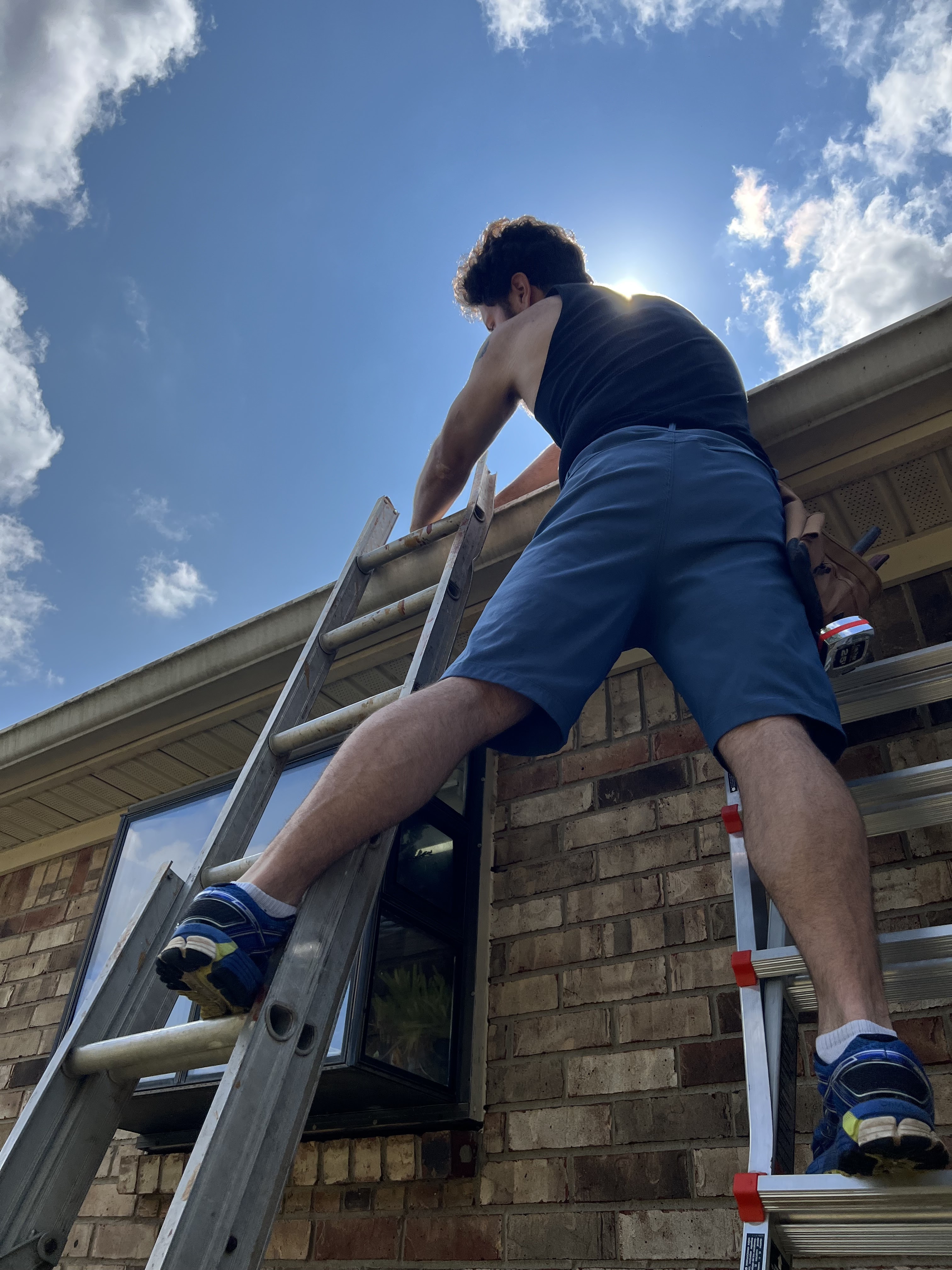
Now, Cammy is pretty tuckered out after working eight hours in the heat every day so he has been trying to work a few hours over the weekends to install the gutter guards. I have been going with him as his “assistant”. I am not of much assistance, but I have handed him what he needed a few times, picked up a few screws he has dropped, held the ladder, and prayed that God would keep the ladder steady and Cammy safe. So far, so good.

Well, yesterday was a clear Saturday, so Cam and I went to Mom and Dad’s to put up some more gutter guard. It was a BEAUTIFUL day to work outside! The clouds were gorgeous, the sun was shining, air quality was in the good range, and humidity wasn’t high. There was a lovely breeze that provided a cooling caress. It really could not have been a more perfect day!

As Cameron was setting up for work, I noticed all of the hickory nuts on the hickory tree. I took out my phone and took photos of the bounty. There were a few web worm nests scattered throughout the tree and as I was taking photos of the hickory nuts, I noticed some of the worms on one of the branches. Seeing those web worms made me think of my brother David.


Mom says that when we were small and lived in Ohio, we were supposed to make our beds in the mornings. David always had his bed made way before I had finished making mine. Mom got suspicious and checked David’s bed. Well, David had been putting on the spread but was stuffing the other covers behind the bed.

During her explorations, Mom noticed an “empty” Prince Albert can and pop bottle under David’s bed. Now, there was an apple tree in our front yard and it was full of web worm nests. When Mom  pulled that empty can and bottle from under the bed, they were not empty. They were filled with web worms!


Well, Cammy had gotten set up and was working while I was ladder steadying and praying, I couldn’t help but admire the fine young man that Cammy has become. He is a hard worker, and he does the job as right as he possibly can! He is very good at brainstorming and figuring out how to fix problems that come up. I reckon that he has inherited some Appalachian ingenuity and knows how to use YouTube as backup. I reckon that our Appalachian folks could have figured out how to travel from one galaxy to the next as easily as traveling from one holler to the next if they had had YouTube!

Yes, Cammy has grown into a fine young man. He has two sisters who are fine young ladies. I am proud to say that I have had three children and each of them makes the world a better place.

Well, I am rambling. I watched Cammy climbing the ladder, sometimes one foot on one ladder and one foot reaching across to another ladder beside it. Seeing Cammy straddle those two ladders make me think of all the family members who worked in tobacco back in the day. I could imagine those boys up in the rafters, leaning down to reach for a stick of tobacco to hang to dry; sometimes straddling those rafters up in that old tobacco barn.


I imagine that Momma was in the house, preparing dinner for when her family finished their work; preparing their dinner while offering up her own prayers that God keep her family safe.

When I could, I admired the beautiful clouds, I noticed some vultures circling over the field behind Mom and Dad’s house. Now, the Stones River National Battlefield is just beyond the field that backs up to their property. Seeing those vultures put my mind to the days after that battle. I wondered how many vultures circled the air above that scene of carnage. The stench of decaying flesh must have drawn many.


I don’t know if any of my ancestors fought at the Battle of Stones River. I do know that past family members fought in the Civil War, some for the Confederacy and others for the Union. They may not have fought on that battlefield, but other battles produced other scenes of carnage and more vultures circling overhead.

And, that is how web worms, gutter guards, and vultures led to a welcome haunting.

Monday, June 26, 2023

Fast, As In Thinking!


I was very fortunate to be able to spend the first eight years of my life knowing my great-grandmother Amanda Moore Allen. I knew her until her death when I was eight. Most folks called her Granny; family members, the neighborhood kids, friends…


Granny and me; she was a constant in my life until her death. 

When I picture Granny in my mind, I picture a rather robust, roly-polyish lady with gray hair pulled back in a bun wearing a simple housedress covered by an apron. I have seen pictures of her taken within a relatively short time of her death, and she doesn’t look robust at all; she looks rather fragile. Still, the Granny of my memories is  the robust Granny.
 
Olen "Bug" Cantrell and a more fragile Granny Amanda Moore Allen in the kitchen of the Cantrell home


“Fast” might seem to be a stretch of the imagination to associate with this elderly woman, but in my mind, she is the best kind of fast, fast thinking.

When my mother and her siblings were very young, Granny lived just over the hill from the Nolen family in rural Southeastern Kentucky. Granny was often around the family and on one cold winter day, Granny was there.

The Nolen home was a simple wooden structure. It was not insulated and cracks in the walls and between the floorboards allowed the chill of winter to seep into the home. There was no central heat and air back in those days. A fire was lit in the single open grate fireplace to warm the living area of the home. The young Nolen children were standing close to the grate to get warm. Young Fanny was backed up too close to the grate and her nightgown tail caught aflame. Granny saw this and quickly pushed Fanny to the floor rolling the flames out before they could do serious damage. It seems that Granny understood “stop, drop, and roll” as well as any fireman!
 
The young Nolen children, Loretta holding Olen, Lola sitting on right; Fanny standing in front

 
The young Nolens: Billy, Ronnie, and Fanny standing; Loretta sittiig, holding Olen, and Lola sitting on right; 
Johnnie hasn't been born yet.


Later, Granny’s daughter Rachel Allen Nolen, would die, leaving the seven Nolen children, ranging in age from ten months to nine years of age, motherless. For a while, their daddy Boyd tried to keep the children together, but it soon became clear that would not be possible. Places were found for the children to live. Sisters, Lola and Fanny, and the three older boys, Billy, Ronnie, and Olen would go to the childrens’ home in Danville, Kentucky. Later, the boys would go to the children’s home in Louisville, Kentucky. Fanny and Lola went to a girls’ home in Midway. The oldest sibling, my mother Loretta, and the youngest, Johnnie went to live with Alta Allen Cantrell, Rachel’s sister’s family in Ohio.
 
Nolen siblings at the Danville home; Fanny, Ronnie, goofing Olen in front of Lola, and Billy


Front: Johnnie Nolen, Linda "Kookie" Cantrell, Denny Cantrell, and Dale Cantrell
Back: Granny Mandy Moore Allen, Loretta Nolen Smith, Alta Allen Cantrell, and Olen "Bug" Cantrell
 

I reckon the Nolen boys were a bit much for the Danville home to handle. They were sent back to Boyd, their daddy, and he was told that another home would have to be found for them. Granny was helping out her son-in-law, trying to keep an eye on them.

Ten-year-old Billy was chopping wood. His seven-year-old brother Olen began pestering him to give him the axe so he could chop wood. At first, Billy told him no, because he would chop off his foot. Olen kept insisting and finally Billy relented and gave him the axe. Well, the first swing Olen took, he struck his big toe, nearly cutting it off. Granny came running. She wrapped the wound in kerosene-soaked rags and sugar and tended it until the boys left for Louisville.

There in Louisville, the campus nurse sent Olen to the local hospital. The doctor unwrapped Olen’s foot and asked who had taken care of it. Olen told him that his Granny had. The doctor was surprised that It was healing so well. He told Olen that Granny’s quick actions had likely saved his toe, and maybe more.

Uncle Olen still has a scar across his big toe, but the toe is still there; his foot is still there, and he still lives. Pricking a toe on a briar led to blood poisoning and death for my young great-uncle Corbitt. Uncle Olen’s accident could have led to the same save for Granny’s quick thinking and actions.

On another occasion, Granny saved the life of my Uncle Johnnie. Uncle Johnnie was just a toddler. Somehow, he had gotten hold of a jawbreaker. As he toddled across the porch, he began to choke on the jawbreaker. Mom says that he was turning blue when Granny came running. Granny whipped up Johnnie by his feet to hang him upside down, and then she began thumping on his back. She kept thumping until the jawbreaker flew out of Johnnie’s mouth and rolled across the porch. Mom is certain that if it hadn’t been for Granny’s quick thinking and actions, little Johnnie would have choked to death. He had been turning blue before Granny took action.
 

                                      Young Johnnie Nolen

Uncle Olen told me of another incident when it is possible that Granny had saved the life of my Cousin Dale. Dale is the son of Olen “Bug” and Alta Allen Cantrell. Alta had taken in Loretta and Johnnie Nolen when her sister Rachel had died. The other Nolen siblings would be picked up from Kentucky and brought to Ohio for holidays and during summer breaks. They would stay with Aunt Alta and other family members in the area. During this occasion, Fanny was staying with Aunt Alta.

Fanny’s brother Olen and Alta’s son Dale are about the same age and they could get into some mischief when they got together. On this occasion, the boys were around nine. Fanny was in the bathroom taking a bath. The boys decided that they were going to get a bucket of cold water and dump it on her while she was bathing. Well, they filled the bucket with cold water. They quietly entered the bathroom where Fanny, unawares, bathed behind the shower curtain.

The boys reached the bucket up over the curtain and dumped the cold water on Fanny. Olen says that they had barely got the bucket down when Fanny, madder than a wet hen and naked as a jaybird burst from the tub. After a brief moment of shock, the boys took off running. They ran out the back door and Fanny grabbed Granny’s butcher knife from the counter and ran right behind them. Olen said that Fanny was madder than he had ever seen her! As they ran around the house, Dale yelled to Olen, “We are really in trouble now!” Uncle Olen yelled back, “You mean you’re in trouble! I know that I can run faster than you!’’
 

                             Granny's butcher knife

So, there was my tiny Aunt Fanny, running outside, butt-naked brandishing Granny’s huge butcher knife, mad as could be, chasing two boys running for dear life. Olen says that they were on about the second lap around the house when Granny stepped out of the back door snagging Fanny up just as she ran around the corner, close on the heels of Dale and Olen. Olen is convinced that Granny had saved their lives, or at least Dale’s life!
 

Nolen children visiting Aunt Alta: Fanny Nolen, Kookie Cantrell, Ronnie Nolen, Olen Nolen, Johnnie Nolen, and Dale Cantrell on the end. Fanny and Dale are separated and she seems to be giving a chagrined Dale the side-eye. She may have just gotten out of the tub! 


Fanny Nolen and Dale Cantrell must have buried the hatchet instead of the butcher knife!

 
Olen, Ronnie, and Johnnie Nolen with Dale Cantrell. Our family was close-knit. 


Sadly, at least for her loved ones, Granny was fast in parting this life also. One day she called Mom and asked her if she could come take her to the doctor. Mom got my brother and I into the car and drove the short distance to Aunt Alta’s house where Granny lived. Mom took us to the neighbor, Mrs. Cecil’s house while she took Granny to the doctor. Mom asked Granny what was wrong. Granny told her that she thought she was dying. Mom asked her if she was afraid of dying and Granny replied, “No, Rett, I’m not afraid, I’m ready.”

Unfortunately, Granny was right. The doctor sent her to the hospital and there her heart stopped and they could not revive her. She was my sweet, wonderful Granny one moment, and in the blink of an eye she was gone. She was ready, but those she left behind were not.